
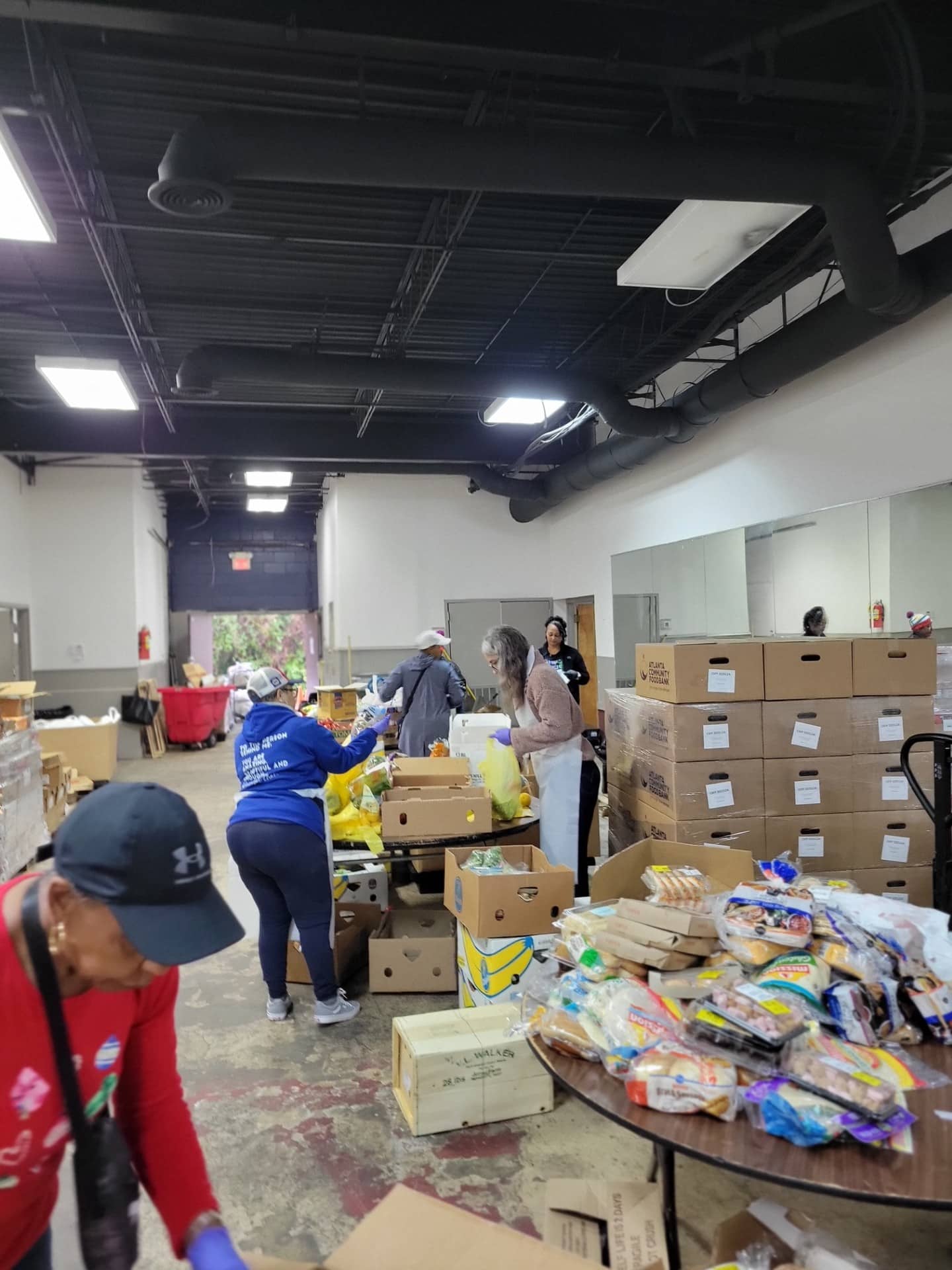
ATLANTA — [Dec. 15, 2025] — The Fulton-DeKalb Hospital Authority (The FDHA), along with a coalition of community organizations and ministries, announces today the formation of a Fulton/DeKalb Food Security Collaborative, an area network designed to strengthen the coordination and long-term impact of addressing food insecurity across Fulton and DeKalb counties.
Backed by an initial $150,000 investment from The FDHA, the collaborative will support organizations with proven track records of serving food-insecure residents. Short-term grants will be distributed and used now through January 31, 2026, and have been awarded to the following organizations to boost their reach and efforts:
- SCLC W.O.M.E.N., Inc.
- Big Bethel AME
- First African Community Development Corporation
- South Atlantic Conference, Seventh Day Adventist Church
- New Life Community Alliance/ATL
- Antioch Urban Ministries Inc.
“We care about food security, because access to food directly impacts health. It’s hard to be healthy if you’re hungry,” said Jevon Gibson, CEO, The Fulton-DeKalb Hospital Authority. “At its core, this collaborative is about working together—pooling insight, boots-on-the-ground experience, and gaining a deeper understanding of the needs of our communities to make sure people don’t fall through the cracks. We’ve seen that the food security safety nets in Fulton and DeKalb counties have holes in them, and we are not interested in seeing band-aids put over holes. We need new nets.”
The newly formed collaborative reflects a shared belief that sustainable solutions require intentionality, forward-thinking, and true collaboration. During the initial convening, partners worked collaboratively to identify gaps and opportunities, emphasizing the role of pride, stigma, transportation, and awareness in providing access to food to those in need. With a diverse group of voices at the table, the collaborative network aims to stay closely informed about community needs while improving alignment, reducing waste and the duplication of services.
“The recent SNAP funding issues have reminded us that the time to act is now, but many of our organizations have been committed to this work for years,” said Rev. Terry L. Hightower, Executive Director of Antioch Urban Ministries, Inc. “What also concerns us is the real impact of new SNAP requirements that could cause some of the people we currently serve to lose benefits. For families already working hard to stay afloat, even a small disruption in support can create a serious gap. That’s why it’s encouraging to sit at the table with organizations willing to share knowledge, align resources, and reduce duplication. We’re grateful to be part of a collaborative effort focused on sustainable solutions that strengthen access to food for Atlanta residents now and in the future.”
To further strengthen food security efforts across Fulton and DeKalb counties, The FDHA, the collaborating partners mentioned above, in addition to The Atlanta Community Food Bank, Southwest Atlanta Cares, and the City of Clarkston, will explore innovations that enhance communication and coordination among food security partners in an effort to more effectively source and distribute food. They are also eager to invite other organizations to join this group to enhance coordinated efforts throughout the region.
According to Gibson, The FDHA will continue to facilitate and convene partners in the community to most effectively and efficiently fill the gaps in care and services regarding various community issues by:
- Curating best practices and evidence-based strategies
- Convening partners to share knowledge and eliminate silos
- Collaborating to strengthen systems and reduce duplication
- Tracking outcomes and measuring progress
- Documenting lessons learned and refining approaches
- Creating a repeatable model—learn, improve, and “rinse and repeat”
In 2026, The FDHA will introduce a multi-year food security funding opportunity through a competitive and cooperative agreement process.
About The Fulton-DeKalb Hospital Authority
The FDHA was established to ensure that all residents of Fulton and DeKalb counties have fair and equitable access to quality health care regardless of their social and/or economic condition. Our mission is through collaboration with Grady Health System and innovative strategies; we will improve health outcomes in Fulton and DeKalb counties. We strive to promote health and wellness by actively seeking opportunities to strengthen the continuum of prevention and care resources available to residents of Fulton and DeKalb counties Working collaboratively with Grady and a cadre of committed community partners, we are focused on closing the gaps in our health ecosystem. As a hospital authority, a large subset of our efforts centers around ensuring that the under resourced and underserved residents of Fulton and DeKalb are connected to quality prevention and care services and resources.
As a quasi-governmental agency, The FDHA provides oversight and support for Fulton and DeKalb counties’ interests in the provision of quality healthcare through the Grady Health System. The FDHA is the material owner of Grady facilities and has a vested interest in the overall performance of the health system and its responsiveness to the healthcare needs of the residents of Fulton and Dekalb counties.
MEDIA CONTACT
Betsy Helgager Hughes
BLH Consulting, Inc. on behalf of The Fulton-DeKalb Hospital Authority
404-771-9793
betsy@blhconsulting.net


